
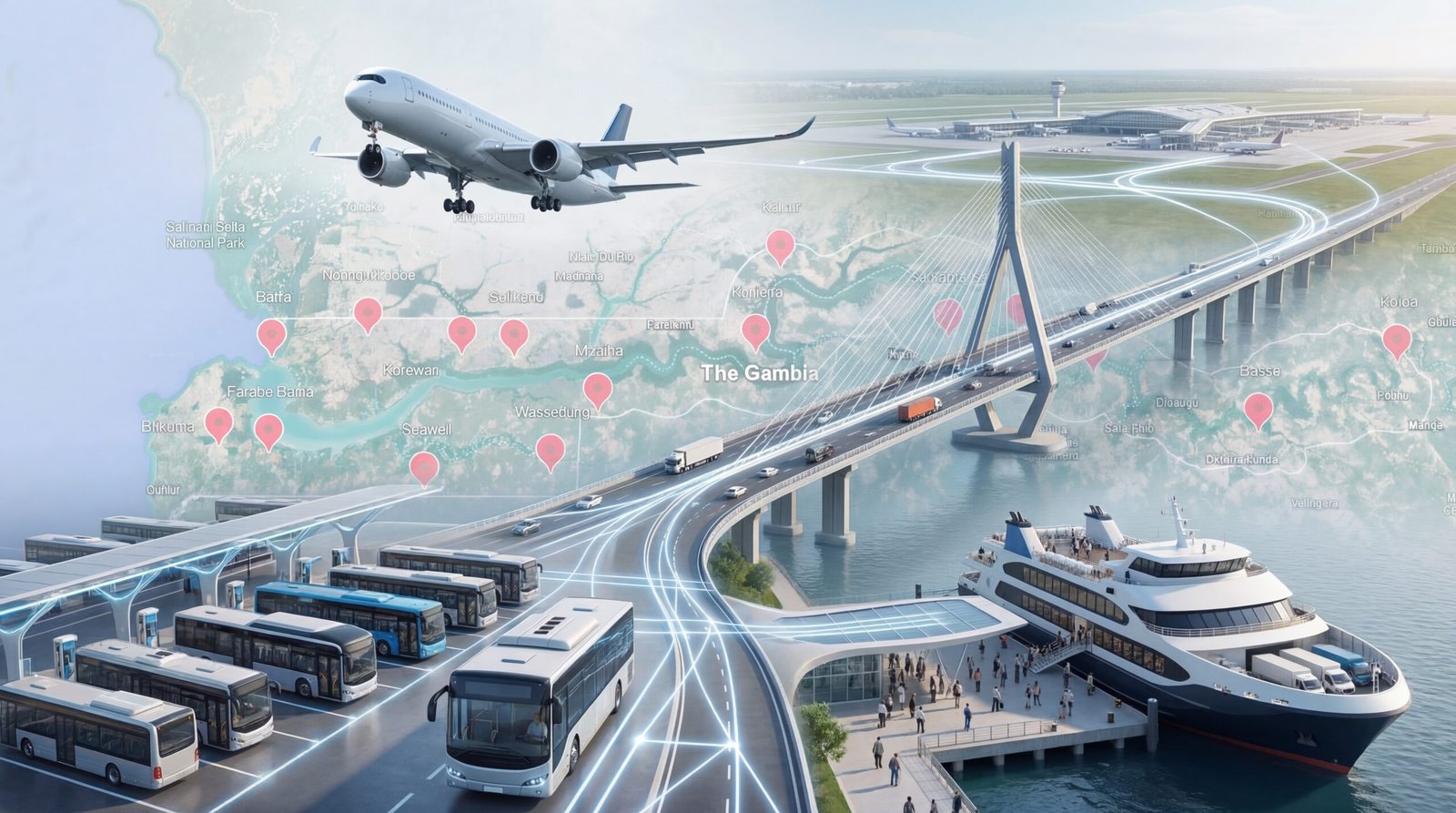
Getting from one part of The Gambia to another is, for most Gambians, an exercise in uncertainty. The bush taxi and van system that carries the majority of travellers is unregulated, priced by negotiation rather than published fares, and organised around vehicle owners' commercial interests rather than passengers' needs. Routes concentrate on corridors that generate revenue. Underserved areas receive little or no service. Vehicle condition and driver behaviour that no transport authority effectively oversees contributes to road accidents that kill and injure Gambians at rates no serious government can accept. During the rainy season, communities across the interior are routinely cut off by flooded or collapsed road surfaces. Agricultural produce spoils. Patients cannot be moved. Children cannot get to school. Logistics costs are high because supply chains cannot rely on predictable transit times. The transport system, as it exists today, limits the potential of every other investment the NBP is making in healthcare, education, agriculture, and economic development. That changes with this plan.
A Gambia where a person in Basse can board a scheduled, clean, safe, and affordable bus and arrive in Serrekunda without uncertainty about when they will get there or how much it will cost. Where the road from any village to the nearest town is paved, drained, and navigable in all seasons. Where a domestic flight from Banjul to Basse takes forty minutes instead of a full day's road journey. Where a logistics operator can move goods from farm to port on a timeline they can plan around. Where a bus terminal is a dignified, comfortable, and well-organised gateway to your journey rather than a chaotic roadside gathering. Where getting from one part of The Gambia to another is a routine convenience, not a logistical challenge. That is the transport system the National Builders Party will build.
The NBP will establish the National Transport Authority as the apex institution for all surface transport in The Gambia, consolidating fragmented responsibility under a single body with genuine planning, licensing, and enforcement powers.
The NTA will be established by Act of the National Assembly with defined powers covering vehicle and operator licensing, route planning and allocation, safety standards enforcement, tariff oversight, and transport infrastructure planning coordination. All transport operators, whether individual vehicle owners or large bus companies, must hold a current NTA operating licence as a condition of legal operation. Published maximum fare structures for defined routes will prevent exploitative pricing while allowing operators to sustain viable businesses. A National Transport Act will replace the existing fragmented regulatory framework and establish the legal foundation for every institution created under this policy. An annual National Transport Performance Report will be published covering route coverage, vehicle safety outcomes, accident statistics, fare compliance, and infrastructure progress.

The NBP will establish the National Public Bus Authority to operate a formal, scheduled, national public bus service connecting every administrative region and every district capital in The Gambia.
The NPBA will be a government-owned enterprise with its own board, budget, and published performance targets, starting with the highest-volume corridors and expanding systematically as fleet and capacity grows. All buses will be branded under a national transit identity, equipped with safety features, comfortable seating, GPS tracking, and route signage. Fares will be set at levels that make the service genuinely affordable for Gambian households, with a published fare schedule for all routes approved by the NTA. Student and elderly discount fares will be available on all NPBA routes. A mobile ticketing application and USSD-based ticketing will allow passengers to purchase tickets in advance and track the real-time location of the next bus on their route. Local mechanics and service technicians will be trained to maintain and service the fleet, creating skilled employment within The Gambia.
The NBP will build modern bus terminals in major towns and cities across every region, giving every Gambian traveller the covered waiting areas, clean facilities, and real-time information that a dignified journey begins with.
Major hubs will be built in Banjul, Serrekunda, Brikama, Farafenni, Soma, Bansang, Basse, Janjanbureh, and all district capitals. Every terminal will include covered waiting areas with adequate seating, electronic ticketing and scheduling systems, a central information board displaying schedules and fares in real time, designated departure and arrival bays with clear signage, clean toilet facilities with separate provision for men, women, and persons with disabilities, a nursing and baby care room, disability-accessible design throughout, a small licensed commercial area for food and essential goods vendors, CCTV coverage of all public areas, a first aid station with a trained first aider on duty, and an NTA compliance desk where passengers can report fare overcharging or safety concerns.
The NBP will build a modern domestic airport in the Basse area, cutting the journey from the Upper River Region to Banjul from up to eight hours by road to forty minutes by air, and anchoring economic development in The Gambia's most underserved region.
The Upper River Region is The Gambia's most geographically remote and economically underserved area. A domestic airport changes this calculation fundamentally. A forty-minute flight replaces an eight-hour drive, opening the eastern regions to commercial, medical, and tourism activity that is currently impractical. The airport will be designed to meet the standards of a modern regional airport capable of serving small-to-medium passenger aircraft, cargo operations, and emergency medical air evacuation. It will be planned with future expansion capacity in case the airport grows beyond its initial parameters. The airport sends a clear signal to investors, development partners, and the communities of the east that this government is serious about regional equity. Construction begins in Year 1 and the inaugural Banjul to Basse air service launches in Year 3.
The NBP will treat road safety as a public health priority, establishing a National Road Safety Authority and investing in vehicle inspection, driver licensing reform, road design standards, and traffic law enforcement to systematically reduce road deaths.
A mandatory annual vehicle roadworthiness inspection for all public passenger and commercial vehicles will ensure that mechanically unfit vehicles are taken off the road. The driver licensing system will be reformed so that a licence is a genuine certification of competence, not a document obtained through informal payments. A driver demerit points system will track offences and automatically suspend the licences of persistently unsafe drivers. All new and rehabilitated roads will include markings, speed limit signs, pedestrian crossing markings, and street lighting as standard. School zones, market areas, and hospital approaches will have speed management infrastructure. A dedicated traffic police unit will enforce drink-driving, mobile phone use while driving, and vehicle overloading with consistent, nationwide enforcement.
The NBP will ensure that rural and underserved communities are not left behind by the national bus network, and will create a pathway for informal transport operators to transition into a regulated, professionally supported sector.
A Rural Bus Service Fund, drawing from vehicle licensing fees and fuel levies, will subsidise routes that serve communities with too little commercial traffic to attract private operators. The NPBA will not attempt to replace the informal sector overnight. It will start with the highest-volume corridors and expand systematically, with the regulated network gradually absorbing routes that informal operators currently serve. An Informal Sector Transition Programme will support minibus and taxi owners to upgrade their vehicles, obtain NTA licences, and join the regulated transport system as compliant operators. Cross-border routes to Senegal and other ECOWAS member states will be expanded and regularised as the domestic network is established, boosting regional trade and enabling Gambian operators to participate in the broader West African transport economy.
The NBP will build a unified national digital transport platform connecting every mode of public transport in The Gambia, giving passengers real-time information, mobile ticketing, and seamless multi-modal journey planning from a single application.
The National Transport Digital Platform will provide real-time bus tracking and estimated arrival times for all NPBA routes, mobile and USSD ticket purchase for buses and ferry crossings, journey planning tools combining bus, ferry, and taxi options, fare comparison and route information for all regulated services, and safety reporting tools enabling passengers to flag concerns directly to the NTA. The platform will be accessible on smartphones and via USSD for passengers without data access, ensuring that digital transport tools reach Gambians across all income levels and locations. Ferry departure times will be displayed alongside bus arrival times at terminal information screens and through the app, allowing passengers to plan multi-modal connections accurately. Full integration of all transport services on the platform is targeted for Year 4.
The National Builders Party will upgrade Banjul International Airport to a modern international standard, improving the passenger experience, expanding handling capacity, and positioning The Gambia as a competitive aviation hub for West Africa.
A full terminal upgrade will modernise the passenger experience from arrival to departure, with improved immigration and customs processing, expanded departure lounges, upgraded retail and dining facilities, disability-accessible design throughout, and digital passenger information systems. Airside infrastructure improvements will expand the airport's capacity to handle increased aircraft movements and cargo volume. The upgrade will support the NBP's tourism ambitions by creating an arrival experience that reflects the country's ambitions rather than undercutting them. The Banjul International Airport upgrade will be completed within the first term, ready to welcome the increased visitor numbers that the NBP's tourism investment is designed to attract.
For Everyday Travellers
A published timetable. A published fare. A clean, covered terminal with toilets and seating. A bus that is on the NTA register, has passed its roadworthiness inspection, and is driven by a licensed professional. A mobile app that tells you where the next bus is and lets you buy your ticket before you arrive. The uncertainty, the negotiated fares, and the overcrowded vehicles that make every journey a gamble are being replaced with a system that treats you as a passenger who deserves to know when the bus is coming and how much it costs.
For Young Gambians
Reliable transport connects you to opportunities that geography currently puts out of reach. A university in another region. A job in a city on the other side of the country. A market for your produce or your business. The forty-minute flight between Basse and Banjul means that the Upper River Region is no longer the far end of the country. It is forty minutes away. For young Gambians in the east, the domestic airport is not just an airport. It is an economic statement that this region matters and will be connected to the rest of the nation.
For Every Family
When roads are paved and passable year-round, your community is no longer cut off during the rainy season. Agricultural produce reaches the market before it spoils. A family member who needs hospital care can actually get there. Children can get to school reliably. When the transport system works, every other government investment in healthcare, education, and economic development becomes more effective. The roads, buses, terminals, and airports the NBP is building are not just transport infrastructure. They are the connective tissue of a functioning nation.
The New National Standard in transport is this: no community in The Gambia is isolated by a road that does not exist, a bus that does not come, or a bridge that has never been built. Every Gambian can travel safely, affordably, and on a schedule they can rely on. Agricultural goods move from farm to market without spoiling on impassable roads. A patient in the Upper River Region can reach specialist care in Banjul in the time it takes to fly, not the time it takes to drive. The national road network is paved, maintained, and safe. The buses run on time. Every public vehicle has passed its roadworthiness inspection and every driver holds a licence that means something. Every terminal is clean, covered, and connected to real-time information. The national digital platform connects every mode of transport in one place. That is not a distant aspiration. It is an engineering and governance commitment. The National Builders Party will build every element of it.
A nation that cannot move its people and its goods cannot build its economy. The roads, the buses, the terminals, the airport, and the digital platform the National Builders Party will build are not just infrastructure. They are the pathways to a connected, productive, and unified Gambia.